|
Category
Management
|
|
|
Your
Experience |
Your
Solution |
| Buyers rejects you. They do not understand or appreciate your products. | Learn
to understand and use Category Management to your advantage and earn
money. |
Category Management (Retail)
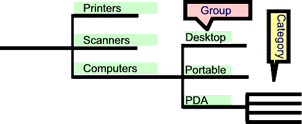
Category Management is widely used in Off-line retail today. Understanding this philosophy is a critical success factor. This chapter will give you a crash course in understanding and taking advantage of Category Management. In short - Category Management is a philosophy used to determine the assortment since shelf space is limited. Understanding Category Management will enable you to focus on the right arguments. Even if you deal with retail companies that do not use Category Management, you will benefit from doing what would be required. Category Management (Etail) On-line stores rarely use this philosophy today. They are to depended on the advertising income from you. In a longer run some On-line stores must be expected to use the philosophy since the shelf space in reality is that of your computer screen. What Category Management is Category Management is, when retail has placed all products into defined categories. The categories are (should be) defined by the customers, making it easier for the customers to get an overview of the products available. Each category has a certain number of products. The categories are combined in groups and groups can be merged. The groups are then placed in a product hierarchy (see example below).
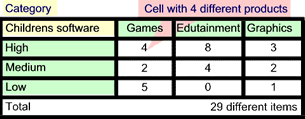
Through the hierarchy, retail can easily monitor i.e. sales and profits. By moving down the hierarchy, retail can easily focus on specific products. Each retail company can have their own definitions of categories. How does it work? A category could
be 29 different software products for children. Each product is
i.e. defined as high, medium or low quality. At the same time,
they are defined as games, edutainment, or graphics. In the table
below you can see that each cell in the category has a certain
number of products.
Retail focus on the categories and not necessarily on each product. The mix of products is used by retail to optimize their profit. To complete a category, retail can have products that customers expect to be there but not necessarily buy when they see the alternatives. Retail also regularly needs new products to make the shopping experience ever exciting. You can certainly use this way of thinking to your advantage. However, the first task is to define the category where your product belongs.
|
Where does my product fit in? You can zero in on the category your product belongs to by undertaking field research at the stores that belong to the chains you want to contact.. So you need to register ALL the products and their street prices that the selected retailer has in the assortment that could be in the category. If it is software - you should register all software products. List this for all the competing chains you visit in the retail business you want to sell too. You could then start focusing on the chains with the largest number of products in your category as they obviously understand your product best and are more likely to test your product(s). That sales success can be used as a strong argument when negotiating with other stores. Developing your Category strategy Once you know which category (and cell within the category) your product belongs, you can start developing your strategy. Focus on one
of the following 3 strategies: 1. Pushing out competing product Evaluate the strengths and weaknesses of your product compared to a specific competing product. You must be able to communicate the strengths of your product compared to competing products in an easy, logical, and understanding fashion.. Do not use technical language – unless that is the language for the specific chain/target customer group. All retailers are looking for category killers. A category killer is a product that generates almost all the sales in a category. A simple example of a category killer was for some years the Palm Pilot. If you have such a product and can explain the benefits from the consumer’s point of view – you’ve got a winner. 2. Expanding a category If you find that your product cannot beat a competing product, you can argue for expanding a whole category. Your product might be useful as a way to complete a category. 3. Establishing a new type of product (and category) All new products are forced into an existing category. New categories are first established when the sales of a product type exceed a certain sales and on the same time do not really fit into the existing category they were originally placed in. Use the salespeople in stores actively. They should (but are not always) be aware of the category management policy of the chain since selling-up strategy is built on this awareness. Selling-up strategy is an old trick where retail attracts customers with low prices that often mean lower profits. It is the task of the headquarters to feed the salespeople with the selling-up arguments/information so they know which products they shall sell to customers and which sales arguments to use. This can be done in combination with sales incentives. Getting in through the backdoor Category ambassadors are selected vendors that have made an agreement with the retail chain to share sales & research information for a specific category. This allows retail to save some manpower/finance, but at the same time, they lose some independency. The selected vendor on the other hand has to give neutral research information on competing products in the same category. If the retail chain finds out that the vendor does not give enough neutral information - the vendor lose the privilege of being a category ambassador. If you can find out if a retail chain uses this philosophy, it will give you an extra opportunity for getting your product(s) on the shelves by cooperating with the category ambassador. So even though it is still the retail chain that will decide if your product will be part of the assortment a category ambassador can actually help by becomming YOUR ambassador. Once you have been accepted in an assortment, you can help retail increase the sale of a whole category (and thereby also your own sales) by giving retail information about other products they need in the assortment and how to present them. The retail chains are always interested in obtaining solid arguments on how they can increase their sales/profits. Over time this initiative can potentially make you a category ambassador..
Jens Welling |
The author of this article Jens Welling has worked with retail purchase, retail sales and retail marketing over the last 15+ years. Jens Welling has written a number of articles as a good source for any new and established company who want success with retail sales. Below are short descriptions and links to other articles. |
|
Why You Have To Do Your Homework Choosing Sales And Distribution Channels Category Management Unique Selling Points (USP) Price Strategy What The Buyer Wants To Know Exit Strategy Price Setting |
Negotiation Tactics Rejection From Buyer Marketing Strategy Education Management Warranties Building A Brand Logistics Keeping Your Store Sales Alive Product Development |